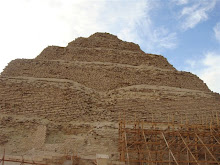
"Creation is speeding up...if you feel a little overwhelmed from time to time - get used to it - or get over it... it will keep on accelerating."
Mayan Calendar Comes North - 2004 - Part 1
http://video.google.com/videoplay?docid=-8689261981090121097
Mayan Calendar Comes North - 2004 - Part 2 http://video.google.com/videoplay?docid=-567329528148516232
Monday, 20 August 2007


Monday, 13 August 2007
Meteor showers
Meteor watching from around 12.15-1.15am - fairly clear sky, after about half an hour spotted one tiny one followed shortly by another. A bit later, two larger ones with tails, one straight after the other. Another little one towards the end. Blink and you miss them, definitely worth the wait, but gazing up at the night sky gets to be a major pain in the neck after about an hour.
Sunday, 5 August 2007
Rainy days
As the people of Gloucester recover from the aftermath of the floods, it has to be noted that the area has a history of such problems:
Dr Foster went to Gloucester
In a shower of rain
He stepped in a puddle
Right up to his middle
And never went there again.
In olden days before tarmac and traffic, this rhyme served as a warning to children to avoid jumping into puddles which appeared shallow but could be much deeper.
Dr. Foster is said to refer to King Edward I of England. He travelled to Gloucester in the middle of a rainstorm. When he arrived, his horse fell and both he and the horse ended up in the middle of a huge mud puddle. The townsfolk had to use planks of wood to remove the king and his steed from the mud. King Edward was enraged by this misfortune and refused to return to Gloucester.
So far I haven’t been able to Google an adequate explanation of why King Edward should be called Dr Foster - apart from the obvious fact that Foster rhymes with Gloucester while Edward rhymes with nothing. (although rhymes could be found for the abbreviation versions Ed or Ted).
Dr Foster went to Gloucester
In a shower of rain
He stepped in a puddle
Right up to his middle
And never went there again.
In olden days before tarmac and traffic, this rhyme served as a warning to children to avoid jumping into puddles which appeared shallow but could be much deeper.
Dr. Foster is said to refer to King Edward I of England. He travelled to Gloucester in the middle of a rainstorm. When he arrived, his horse fell and both he and the horse ended up in the middle of a huge mud puddle. The townsfolk had to use planks of wood to remove the king and his steed from the mud. King Edward was enraged by this misfortune and refused to return to Gloucester.
So far I haven’t been able to Google an adequate explanation of why King Edward should be called Dr Foster - apart from the obvious fact that Foster rhymes with Gloucester while Edward rhymes with nothing. (although rhymes could be found for the abbreviation versions Ed or Ted).
Monday, 30 July 2007
Da Vinci double take
Claims that a double take of Leonardo da Vinci’s Last Supper reveals a mysterious extra guest have set off a feeding frenzy among internet conspiracy theorists.
The figure appears when the 15th Century mural painting is superimposed with its mirror image, and both are made partially transparent.
The discovery was made by Slavisa Pesci, an Italian amateur scholar, whose maintains that the composite picture appears to depict a figure (possibly a woman) holding a young child.
The double image is rather blurry and faded, making it difficult to draw any firm conclusions.
But the theory is in line with the supposition of the Da Vinci Code, by Dan Brown, which suggests that Jesus and Mary Magdelene could have married and had a child.
Leonardo da Vinci websites received millions of hits following the announcement.
Source: www.telegraph.co.uk
websites - www.leonardodavinci.tv, www.codicedavinci.tv, www.cenacolo.biz and www.leonardo2007.com -
The figure appears when the 15th Century mural painting is superimposed with its mirror image, and both are made partially transparent.
The discovery was made by Slavisa Pesci, an Italian amateur scholar, whose maintains that the composite picture appears to depict a figure (possibly a woman) holding a young child.
The double image is rather blurry and faded, making it difficult to draw any firm conclusions.
But the theory is in line with the supposition of the Da Vinci Code, by Dan Brown, which suggests that Jesus and Mary Magdelene could have married and had a child.
Leonardo da Vinci websites received millions of hits following the announcement.
Source: www.telegraph.co.uk
websites - www.leonardodavinci.tv, www.codicedavinci.tv, www.cenacolo.biz and www.leonardo2007.com -
Friday, 27 July 2007
Harry Potter and the Order of the Phoenix
Most quotable line: "Just because you can do magic now doesn't mean to say you have to whip your wands out all the time." (slightly paraphrased, apologies)
Most memorable cameo role: Helena Bonham Carter as Bellatrix Lestrange.
Plenty of scope for wild hair, Gothic chic and manic cackling.
Most over-hyped aspect of the film: Harry's budding romance with Oriental beauty Cho Chang, apart from one screen kiss under some fast-growing mistletoe (the plant is more dynamic than the couple) she barely gets a look-in.
Nit-picking niggle: At the beginning of the film, the Pegasus-like winged horses (I think they're called Thestrals?) are visible only to those who have witnessed death. Towards the end of the film, Hermione, Ron et al fly on these horses, apparently unconcerned by the fact that their rides are invisible to them. (I don't think anyone had died in their presence at that point? maybe it's clearer in the book.)
Minor gripe: The film is a little overlong, I suppose the book is long and they were trying to cram it all in, but maybe a bit more judicious pruning could have kept it to the two hour mark.
Most memorable cameo role: Helena Bonham Carter as Bellatrix Lestrange.
Plenty of scope for wild hair, Gothic chic and manic cackling.
Most over-hyped aspect of the film: Harry's budding romance with Oriental beauty Cho Chang, apart from one screen kiss under some fast-growing mistletoe (the plant is more dynamic than the couple) she barely gets a look-in.
Nit-picking niggle: At the beginning of the film, the Pegasus-like winged horses (I think they're called Thestrals?) are visible only to those who have witnessed death. Towards the end of the film, Hermione, Ron et al fly on these horses, apparently unconcerned by the fact that their rides are invisible to them. (I don't think anyone had died in their presence at that point? maybe it's clearer in the book.)
Minor gripe: The film is a little overlong, I suppose the book is long and they were trying to cram it all in, but maybe a bit more judicious pruning could have kept it to the two hour mark.
Friday, 20 July 2007
St Swithin's Day: yet more showers?
The bad news – it rained on St Swithin's Day.
The good news – Met Office records show that in past years, bad weather on this day (July 15) has not always been followed by 40 continuous days of rain.
An old rhyme which has been part of oral tradition since Elizabethan times sums up the legend:
'St Swithin’s Day, if it does rain
Full forty days, it will remain
St Swithin’s Day, if it be fair
For forty days, t'will rain no mair.'
St. Swithin (alternative spelling spelt Swithun) was a Saxon Bishop of Winchester and legend has it that as he lay on his deathbed, he asked to be buried out of doors, at one with nature, where the rain would fall on his grave.
For nine years, his wishes were followed, but then, on 15 July 971, the monks of Winchester attempted to remove his remains to a splendid shrine inside the cathedral . According to legend there was a heavy rain storm during the ceremony, which was taken to be a sign of St Swithin’s protest at the move.
This tale became embellished over time and embedded in folklore.
Fortunately, on numerous occasions in the past, records have shown that rain on this day has not been followed by 40 continuous days of bad weather.
On this occasion perhaps St Swithin could allow for all the retrospective rain of the season to be taken into account and concede that we have already had more than our fair share of storms and showers this summer.
The good news – Met Office records show that in past years, bad weather on this day (July 15) has not always been followed by 40 continuous days of rain.
An old rhyme which has been part of oral tradition since Elizabethan times sums up the legend:
'St Swithin’s Day, if it does rain
Full forty days, it will remain
St Swithin’s Day, if it be fair
For forty days, t'will rain no mair.'
St. Swithin (alternative spelling spelt Swithun) was a Saxon Bishop of Winchester and legend has it that as he lay on his deathbed, he asked to be buried out of doors, at one with nature, where the rain would fall on his grave.
For nine years, his wishes were followed, but then, on 15 July 971, the monks of Winchester attempted to remove his remains to a splendid shrine inside the cathedral . According to legend there was a heavy rain storm during the ceremony, which was taken to be a sign of St Swithin’s protest at the move.
This tale became embellished over time and embedded in folklore.
Fortunately, on numerous occasions in the past, records have shown that rain on this day has not been followed by 40 continuous days of bad weather.
On this occasion perhaps St Swithin could allow for all the retrospective rain of the season to be taken into account and concede that we have already had more than our fair share of storms and showers this summer.
Friday, 13 July 2007
Law of Attraction
The Law of Attraction by Esther and Jerry Hicks is along the same lines as The Secret – whose author Rhonda Byrne was originally one of their followers until they went their separate ways.
Esther takes issue with the title of Rhonda’s book, declaring that “Calling the law of attraction a secret is rather like calling gravity a secret.”
The information supplied by Esther is supposed to be channelled from the spirit world. This makes the message somewhat less mainstream, although Esther still has the endorsement of Oprah Winfrey, which has certainly helped with publicity.
Some of the main points of their philosophy are:
You create what you are with every thought. Whatever you think about, you will receive – be it good or bad.
Your state of being is the way you feel about yourself at any point in time.
When you focus on success as the achievement of happiness you place yourself in vibrational alignment with the universe
If you have been thinking hard about something but have not achieved it, you must be focusing on its absence and hence pushing it away (can be a tricky one to fix, that)
Stop worrying about what other people think and focus on what you want out of life.
Esther takes issue with the title of Rhonda’s book, declaring that “Calling the law of attraction a secret is rather like calling gravity a secret.”
The information supplied by Esther is supposed to be channelled from the spirit world. This makes the message somewhat less mainstream, although Esther still has the endorsement of Oprah Winfrey, which has certainly helped with publicity.
Some of the main points of their philosophy are:
You create what you are with every thought. Whatever you think about, you will receive – be it good or bad.
Your state of being is the way you feel about yourself at any point in time.
When you focus on success as the achievement of happiness you place yourself in vibrational alignment with the universe
If you have been thinking hard about something but have not achieved it, you must be focusing on its absence and hence pushing it away (can be a tricky one to fix, that)
Stop worrying about what other people think and focus on what you want out of life.
Subscribe to:
Posts (Atom)